Osaka, Naraand Hiroshima

A week in western Japan without a car: the neon of Osaka, the deer and the Great Buddha of Nara, the Peace Park of Hiroshima and the Miyajima torii standing in the sea. Between cities — the shinkansen.

places picked
per person
Trip startsStart
Flying fromFrom
TravelersPeople
PacePace
Route

Getting around

Japan · 7 days

Base for the first three nights and the easy jumping-off point for Nara. Minami is the southern half of Osaka: the neon of Dotonbori, the Kuromon market, the Shinsaibashi arcades.

Day by day

Day 1 · 6 placesArrival and a first evening in Minami
KIX → Namba: Nankai Rapi:t, 38 min
  • Дотонбори · 道頓堀
    Osaka’s main street and the reason people come here at night: the canal, neon up the whole wall, the mechanical crab over a restaurant door and the Glico runner the whole city takes its picture under. Takoyaki is eaten standing, right here.
  • Аэропорт Кансай (KIX) · 関西国際空港
    The airport stands on a man-made island in the sea. The Nankai Rapi:t leaves from inside the building and reaches Namba in 38 minutes — that is already the city center, no further changes.
  • Станция Намба · 南海なんば駅
    Where the airport train ends and Osaka begins. From the exit it is a walk to the Namba hotels and to Dotonbori.
  • Синсайбаси-судзи · 心斎橋筋商店街
    A covered shopping street a third of a mile long: shops, drugstores, cafés, sweet stalls. It never rains here — there is a roof overhead — and in the evening it is the thickest crowd in town.
  • Амэрика-мура · アメリカ村
    A quarter of secondhand clothes, record shops and graffiti where Osaka’s young people hang out. The small triangular park is their meeting point.
  • Хоздзэн-дзи Ёкотё · 法善寺横丁
    Two lanes the width of your shoulders, stone paving and lanterns — a hundred yards from the neon of Dotonbori. At the back, a tiny temple with a statue covered in moss: people splash it with water for luck, and the moss only grows thicker.
Day 2 · 7 placesOsaka in one day: the market, the castle, the view from the roof
all day by metro and on foot
  • Замок Осаки · 大阪城
    A white-and-gold keep on black stone walls, with a moat as wide as a river around it. Inside is a museum about Toyotomi Hideyoshi, on top an observation deck. The walk through the castle park is worth as much as the keep.
  • Умэда Скай Билдинг · 梅田スカイビル
    Two towers joined at the top by a round open-air deck. The last stretch is an escalator in a glass tube over the void. Come at sunset: first the mountains, then the whole city in lights.
  • Рынок Куромон · 黒門市場
    A third of a mile of covered market that Osaka calls “the city’s kitchen.” Scallops and tuna are cut in front of you and served on a skewer — that is breakfast here. Come before noon; by evening half the stalls close.
  • Музей истории Осаки · 大阪歴史博物館
    You walk down through the ages from the top floor: a full-size 7th-century palace, the medieval town, prewar streets. And a view of the castle from the tenth-floor window — free, and one of the best.
  • Сад Нисиномару · 西の丸庭園
    A lawn inside the castle walls from which the keep is seen whole and without wires — the best photo spot in the whole castle. Yellow ginkgo here in November.
  • Охацу Тэндзин · 露天神社
    A small shrine squeezed between office towers. In 1703 two lovers took their lives here; a month later a play was written about them for the puppet theater — and people have come here to pray for love ever since.
Day 3 · 9 placesNara: the deer, the Great Buddha and the old quarter
Osaka-Namba → Kintetsu-Nara: Kintetsu Limited Express, 36 min
  • Парк Нара · 奈良公園
    Fifteen hundred spotted deer roam the park on their own: they have been considered messengers of the gods and left alone since the 8th century. For a cracker from a stand a deer bows — nobody taught them, they worked it out.
  • Тодай-дзи · 東大寺
    The main reason people come to Nara. The Great Buddha Hall is one of the largest wooden buildings in the world, and inside sits a 50-foot bronze statue from the 8th century. In a corner is a pillar with a hole the size of the Buddha’s nostril: squeeze through and you get luck.
  • Станция Кинтэцу-Нара · 近鉄奈良駅
    The station sits at the edge of the old town: five minutes on foot to the first temple, seven to the deer. Closer to everything than the JR station.
  • Кофуку-дзи · 興福寺
    The temple of the Fujiwara family, the most powerful in the country for a thousand years. In the Eastern Golden Hall and the treasure house are 8th-century wooden statues, among them the three-faced Ashura, the most famous sculpture in Nara. The five-story pagoda is under scaffolding for restoration.
  • Нигацу-до · 二月堂
    A hall on stilts higher up the slope, ten minutes uphill past stone lanterns. From the open gallery you see all of Nara to the horizon — free, and almost never crowded.
  • Сад Исуйэн · 依水園
    Two gardens joined into one: a pond, tea houses, and in the distance the gate of Todai-ji and the hills are deliberately left in view — the garden was built to borrow them into its scenery. Red maples in mid-November. Closed Tuesdays; our day is Thursday.
Day 4 · 8 placesShinkansen to Hiroshima and the Peace Memorial Park
Shin-Osaka → Hiroshima: shinkansen Nozomi, 1 hr 25 min
  • Музей мира · 広島平和記念資料館
    The museum is not about the bomb but about people: a watch stopped at 8:15, a school uniform, a tricycle. You cannot walk through it fast. There is an audio guide in English.
  • Мемориальный парк мира · 平和記念公園
    The park lies exactly where the busiest quarter of the city stood until August 6, 1945. The cenotaph, the eternal flame and the Children’s Peace Monument with its garlands of paper cranes sent by schoolchildren from all over the world.
  • Купол Гэмбаку · 原爆ドーム
    The one building that stood almost directly under the blast — left as it was, with the bare skeleton of its dome. The city decided neither to rebuild nor to tear it down; today it is a UNESCO site.
  • Станция Син-Осака · 新大阪駅
    All shinkansen to the west leave from here, not from Osaka’s central station. From Namba it is a straight metro ride, about 20 minutes. Bento for the trip is sold right on the platform.
  • Вокзал Хиросимы · 広島駅
    From here streetcar No. 2 runs straight to the Peace Park — twenty minutes and one flat fare. The lockers in the station building come in handy on the last day too.
  • Бывшее отделение Банка Японии · 旧日本銀行広島支店
    A bank a quarter mile from the hypocenter that survived the blast: thick walls, steel shutters. Two days later it reopened and did the work of every wrecked bank in the city. The vault hall and the basement are kept as they were, entry is free — it sits on the way from the park to Hondori.
Day 5 · 8 placesMiyajima: the torii in the water and Mount Misen
Hiroshima → Miyajimaguchi: JR 27 min, then the ferry 10 min
  • Ицукусима · 厳島神社
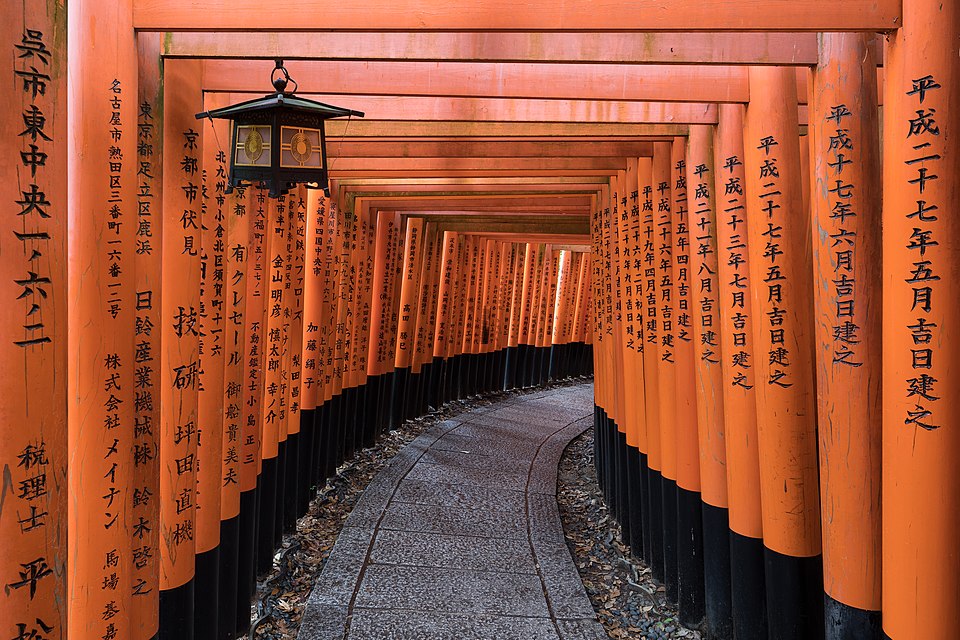
    The shrine is built on stilts right in the sea: at high tide the galleries stand over the water and the whole building seems to float. The island was held so sacred that ordinary people were not allowed to set foot on it — hence the building over the water.
  • О-тории · 大鳥居
    A 53-foot gate standing in the water — the most recognizable view in Japan. Nothing holds it down; it stands by its own weight. At low tide you walk out to it across the seabed; at high tide boats pass beside it.
  • Причал Миядзимагути · 宮島口
    Two ferries run to the island from here, every 15 minutes. In the daytime the JR ferry makes a loop closer to the torii — take that one and stand on the right side.
  • Сэндзёкаку и пагода · 千畳閣・五重塔
    A huge unfinished hall of unpainted wood: begun in 1587 and abandoned when the patron died. Inside it is empty, the wind blows through and you see the sea between the columns. Next to it stands a red five-story pagoda.
  • Дайсё-ин · 大聖院
    A temple on the slope that almost nobody reaches, though it is five minutes uphill. Prayer wheels spin along the stairs, and in the cave under the temple several hundred small figures stand in lamplight.
  • Гора Мисэн · 弥山
    The island’s sacred mountain, 1,755 feet. The cable car takes you almost to the top; the last half hour is over rocks through a forest where wild monkeys and deer walk. From the summit you see the Inland Sea with all its islands.
Day 6 · 7 placesA Hiroshima morning, the shinkansen and an evening on Tenjinbashi
Hiroshima → Shin-Osaka: shinkansen Nozomi, 1 hr 25 min
  • Мемориальный собор мира · 世界平和記念聖堂
    A Catholic cathedral built where the burned church stood, on donations from around the world: the bells came from Germany, the organ from Italy. Quiet inside and almost always empty.
  • Сад Сюккэй-эн · 縮景園
    A 17th-century garden in which a small pond with a bridge repeats the view of a famous lake in China. After the bombing the wounded came here, and several trees that survived the blast still stand. Maples in mid-November.
  • Замок Хиросимы · 広島城
    A dark wooden keep in a wide moat — an exact copy of the one that burned in 1945. Inside is a museum of the samurai town, on top an observation deck. In the grounds grows a willow that survived the blast a kilometer from the hypocenter.
  • Художественный музей Хиросимы · ひろしま美術館
    A small but strong collection of the French — Monet, Van Gogh, Picasso. The museum was built by a local bank “in memory of the dead and for the peace of mind of the city.”
  • Вокзал Хиросимы · 広島駅
    The shinkansen to Osaka leaves from here. Pick up the bags left in the locker in the morning; bento for the ride is on the platform.
  • Станция Син-Осака · 新大阪駅
    The shinkansen from Hiroshima arrives here — 1 hr 25 min on the way. From here the Midosuji metro takes ten minutes to Umeda, fifteen to Tenmangu.
Day 7 · 7 placesSouthern Osaka and the flight
Namba → KIX: Nankai Rapi:t, 38 min
  • Осака Тэммангу · 大阪天満宮
    The shrine of the god of learning: students come here before exams and hang wooden tablets with their wishes. In summer the Tenjin river festival, one of the three biggest in the country, starts from here.
  • Цутэнкаку и Синсэкай · 通天閣・新世界
    A quarter built in 1912 “after Paris and New York” and barely changed since: signs the size of a person, kushikatsu houses, a tower with an observation deck. The oldest and least touristy Osaka.
  • Синтэннодзи · 四天王寺
    The first Buddhist temple built by the state in Japan — the year 593. The buildings have been rebuilt many times, but the layout is the same: gate, pagoda and golden hall on one axis. The grounds are always open, and Monday does not matter here.
  • Абэно Харукас · あべのハルカス
    The tallest skyscraper in Japan, 985 feet. The observation deck takes three floors, part of it an open gallery under the sky; on a clear day you see Kobe, Awaji and the hills of Nara you walked on Thursday.
  • Сумиёси-тайся · 住吉大社
    One of the oldest shrines in the country, built in its own style — not a single Chinese detail, a straight roof and projecting beams. In front of the entrance is a steep red arched bridge you climb almost on all fours. It stands right by the line you take to the airport.
  • Станция Намба · 南海なんば駅
    The airport train leaves from here. Rapi:t tickets are bought at the counter, seats are reserved; the ordinary express takes seven minutes longer and costs half.
Itinerary

Day by day

Tap a day to open it. Every place name links to Google Maps, and each day’s “Directions in Google Maps” link is built from the places you’ve ticked.

Money

What it costs

Everything in one place: nights and what they cost, flights, the car, tickets and food. Change a night or a price and the total follows.

Per day
Per person
Total
Where to eat

Where to eat, city by city

At a glance

Drives and time behind the wheel

DayLegDistanceDrivingTimeWith stopsWith stops
Just so you know

What to book ahead, and the practical bits

Build a trip for my dates

Tell us where and when — we build a personal day-by-day plan.